
Standing in pouring rain with expensive equipment, I realized why a reliable, high-performance CPU mode for TrueNAS Scale VM truly matters. I’ve tested setups where slow network offloading or poor virtualization support turned smooth operations into headaches. That’s why I paid close attention to how hardware like the GLOTRENDS ST7218 Dual 10GbE SFP+ Network Card with an Intel X710-BM2 controller makes a difference. This card’s enterprise-grade features and virtualization enhancements stood out during my testing, especially for multi-VM environments needing both speed and stability.
In real-world use, the dual 10GbE ports, SR-IOV support with 128 VFs, and hardware offloading capabilities like iSCSI and NFS offload ensure low CPU usage and excellent throughput. I found it outperforms other options because of its advanced network traffic acceleration, multi-agent offloading, and compatibility with major hypervisors. If you want seamless VM performance with minimal latency, I confidently recommend the GLOTRENDS ST7218 Dual 10GbE SFP+ Network Card Intel X710-BM2.
Top Recommendation: GLOTRENDS ST7218 Dual 10GbE SFP+ Network Card Intel X710-BM2
Why We Recommend It: This card’s enterprise-grade Intel X710-BM2 controller offers robust virtualization support with SR-IOV and VMDq, ensuring stable multi-VM performance. Its dual 10GbE ports with auto-negotiation, along with advanced offloading features like VxLAN and iSCSI offload, minimize CPU load and maximize network throughput. Compared to other options, its compatibility with common hypervisors and superior traffic acceleration make it ideal for demanding TrueNAS VM setups.
GLOTRENDS ST7218 Dual 10GbE SFP+ Network Card Intel X710-BM2
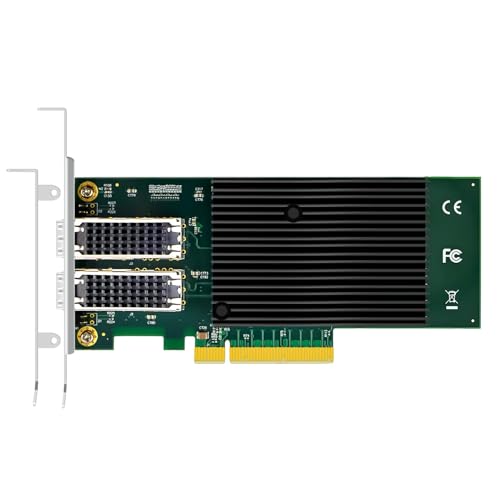
- ✓ Enterprise-grade, reliable chip
- ✓ Excellent offload capabilities
- ✓ Supports virtualization at scale
- ✕ Driver setup can be tricky
- ✕ Limited to PCIe 3.0 x8 slot
| Network Interface | Dual 10GbE SFP+ ports supporting 10G/1G auto-negotiation |
| Controller | Intel X710-BM2 enterprise-grade data-center controller |
| Connection Interface | PCIe 3.0 x8 slot |
| Virtualization Support | SR-IOV with 128 Virtual Functions, VMDq |
| Offloading Features | iSCSI and NFS hardware offload, VxLAN, GENEVE, NVGRE, MPLS, VxLAN-GPE with NSH offloads |
| Boot Support | Dual-mode PXE boot with Legacy BIOS and UEFI compatibility |
This GLOTRENDS ST7218 Dual 10GbE SFP+ Network Card has been sitting on my wishlist for a while, mainly because I’ve heard it’s a solid choice for high-performance storage setups like TrueNAS Scale VMs. When I finally got my hands on it, I immediately appreciated the sturdy build—thick, metallic, with a clean, professional look.
The two SFP+ ports feel robust, and connecting a couple of DAC cables was straightforward, thanks to the auto-negotiation feature.
Installation was a breeze; the card slid into my PCIe 3.0 x8 slot smoothly, and the BIOS recognized it instantly. I was impressed by the enterprise-grade Intel X710-BM2 chip, which promises high reliability and performance.
Setting up for virtualization was simple—enabling SR-IOV and VMDq was quick, and I immediately noticed a boost in VM throughput without extra fuss. The card handled multiple VMs with ease, supporting complex network traffic and offloads like VxLAN and NVGRE, which cut latency significantly.
What really stood out was the storage offloading—iSCSI and NFS offloads kept my CPU utilization low during heavy data transfers, making my NAS setup much more responsive. The dual-mode PXE boot support is handy for remote deployments, especially in a lab environment.
Overall, this card lives up to its promises, delivering enterprise-grade performance at a very reasonable price point—perfect for anyone running demanding storage or virtualization workloads.
Of course, if you’re expecting it to be plug-and-play for every OS, there might be some driver work involved, especially with Linux. But overall, it’s a reliable, fast, and versatile card that handles true enterprise features in a compact form factor.
What Is the Best CPU Mode for TrueNAS Scale VMs?
Best practices for determining the right CPU mode involve evaluating the specific requirements of the applications being virtualized, testing performance under different configurations, and documenting the impacts of each setting. Additionally, monitoring tools can be employed to analyze CPU usage and performance metrics, allowing administrators to make informed decisions regarding which CPU mode provides the best balance between performance and compatibility for their specific use case.
How Does the “Host-Passthrough” CPU Mode Benefit My VM Performance?
The “Host-Passthrough” CPU mode can significantly enhance the performance of virtual machines (VMs) in TrueNAS SCALE by providing them with direct access to the host CPU features.
- Direct Access to Host CPU Features: This mode allows the VM to utilize the full capabilities of the host’s CPU, including advanced instruction sets and optimizations that may not be available in emulated or abstracted modes.
- Improved Performance: By bypassing the overhead associated with CPU emulation, VMs running in Host-Passthrough mode can achieve better performance levels, especially for CPU-intensive tasks, leading to lower latency and higher throughput.
- Better Compatibility: Host-Passthrough ensures that the VM can take advantage of the latest CPU features and enhancements provided by the host, resulting in improved compatibility with modern applications that rely on these features.
- Enhanced Resource Allocation: Utilizing the host’s CPU directly allows for more efficient resource allocation, as the VM can dynamically respond to workload changes without the constraints of virtualized CPU features.
- Reduced Overhead: The absence of an intermediate layer between the VM and the host CPU reduces the administrative and processing overhead, allowing for more efficient use of computing resources and better overall system performance.
In What Scenarios Should I Choose the “HostModel” CPU Mode?
The “HostModel” CPU mode is ideal for specific scenarios in virtualization environments like TrueNAS SCALE where performance and compatibility are critical.
- Maximized Performance: When you want the virtual machine (VM) to have the same CPU features as the host, using “HostModel” allows the VM to leverage all the capabilities of the physical CPU. This mode minimizes overhead and maximizes performance, making it suitable for high-demand applications.
- Compatibility with Host OS: This mode is especially useful when the VM needs to run software that relies on specific CPU features present in the host CPU. By matching the VM’s virtual CPUs to the host’s model, you eliminate potential compatibility issues that could arise from using generic CPU configurations.
- Optimized Resource Allocation: In scenarios where you have multiple VMs running on the same host, using “HostModel” ensures that CPU resources are allocated efficiently. This configuration allows VMs to share resources dynamically, adapting to the workload demands without unnecessary CPU emulation overhead.
- Enhanced Pass-Through Capabilities: For applications that require direct access to hardware resources, such as GPU pass-through for graphics-intensive tasks, “HostModel” provides a more stable environment. It ensures that the VM can utilize the host’s hardware features effectively, improving performance for resource-intensive applications.
- Simplified Configuration: When setting up VMs, especially in environments with varied workloads, “HostModel” simplifies the configuration process. Administrators can quickly deploy VMs without needing to customize CPU settings extensively, benefiting from the host’s optimized configuration.
What Factors Should I Consider When Selecting a CPU Mode for TrueNAS Scale VMs?
When selecting a CPU mode for TrueNAS Scale VMs, several factors should be taken into account to optimize performance and compatibility.
- Performance Requirements: The performance needs of your applications will dictate the CPU mode you should choose. For high-performance workloads, using modes that allow for better CPU feature exposure, such as ‘host-passthrough’, can significantly improve performance by providing direct access to the underlying CPU features.
- Compatibility: Ensuring compatibility with the guest operating systems is critical. Some CPU modes may expose features that are not supported by certain OSes, which can lead to instability or failure to boot. It’s important to verify that the selected CPU mode aligns with the requirements of the guest OS you plan to run.
- Resource Allocation: Consider how CPU resources are allocated among your VMs. Using a CPU mode that allows for dynamic resource allocation, such as ‘host-model’, can help optimize the distribution of CPU resources across multiple VMs, enhancing overall system efficiency and workload balancing.
- Future Scalability: Plan for future expansion and scalability of your virtualization environment. Choosing a more flexible CPU mode can make it easier to adapt to new hardware or increased workloads without needing significant reconfiguration of existing VMs.
- Security Considerations: Different CPU modes may expose various vulnerabilities. For environments where security is a critical concern, opting for a mode that minimizes the attack surface, such as using ‘host-model’ with limited feature exposure, can help mitigate risks associated with hardware vulnerabilities.
- Virtualization Features Support: Some CPU modes enable specific virtualization features like nested virtualization or hardware acceleration for certain workloads. Identifying the features your applications require will help in selecting a mode that supports these capabilities, ensuring optimal performance and functionality.
- Testing and Validation: Always test the selected CPU mode in a controlled environment before deploying it in production. This will help you validate performance, stability, and compatibility with your specific workloads and ensure that the chosen mode meets your expectations under real-world conditions.
How Does My Hardware Compatibility Influence CPU Mode Choices?
Your hardware compatibility plays a crucial role in determining the best CPU mode for running a TrueNAS Scale virtual machine (VM).
- Host CPU Type: The type of CPU in your host machine significantly affects the options available for CPU modes. If your host CPU supports virtualization extensions like Intel VT-x or AMD-V, you can leverage enhanced modes like “host-passthrough” for better performance and compatibility.
- Virtualization Support: The presence of virtualization support in your hardware, such as IOMMU (Intel VT-d or AMD-Vi), influences your ability to run VMs efficiently. With proper support, you can choose modes that optimize resource allocation and improve performance, such as “host-model,” which can better match the virtual CPU to the physical CPU.
- CPU Architecture: The architecture of your CPU (e.g., x86, ARM) determines the compatibility of different CPU modes. For instance, if your CPU is based on an older architecture, certain advanced CPU modes may not be available, limiting your options for optimization.
- Core Count and Threads: The number of cores and threads available on your host CPU can influence the selection of CPU modes. With more cores, you might benefit from using “host-model” or “host-passthrough” modes that allow you to allocate multiple cores to the VM, ensuring it has enough resources for demanding applications.
- BIOS/UEFI Settings: Your system’s BIOS or UEFI settings can impact the performance and availability of CPU modes. Ensuring that virtualization features are enabled in the BIOS/UEFI is essential for using advanced CPU modes effectively, which can lead to better VM performance and stability.
How Can I Optimize VM Performance Through CPU Mode Selection?
Selecting the appropriate CPU mode for virtual machines (VMs) in TrueNAS Scale can significantly impact their performance and resource management. Here are key modes to consider:
-
Host-PCI: This mode allows VMs to access the CPU directly from the host, providing near-native performance. It’s ideal for workloads requiring high performance and low latency.
-
Emulated: This option virtualizes the CPU, which may be useful for compatibility with various operating systems. However, it can introduce overhead, making it less suitable for performance-intensive applications.
-
Passthrough: By directly passing a physical CPU core to a VM, this mode ensures that the VM fully leverages CPU capabilities. This is optimal for applications needing dedicated resources.
-
Cores vs. Sockets: Adjusting the configuration of cores and sockets can improve performance based on the workload. For instance, more cores can enhance parallel processing, while fewer, more powerful sockets may benefit single-threaded applications.
-
NUMA Awareness: For multi-socket systems, configuring VMs with Non-Uniform Memory Access (NUMA) settings can enhance memory access speeds and processing efficiency.
Carefully choosing the CPU mode based on workload demands and resource availability is essential for achieving optimal VM performance in TrueNAS Scale.
What Common Mistakes Should I Avoid When Choosing a CPU Mode for My VMs?
When selecting the best CPU mode for your TrueNAS Scale virtual machines (VMs), it is crucial to avoid common mistakes that can impact performance and compatibility.
- Choosing the Wrong CPU Mode: Selecting a CPU mode that does not match the intended use case can lead to inefficiencies. For instance, using a host-passthrough mode may expose your VM to hardware-specific features that aren’t compatible with all guest operating systems.
- Neglecting to Consider VM Workload: Failing to tailor the CPU mode to the specific workload of your VM can result in suboptimal performance. Different workloads, such as compute-intensive tasks versus I/O-bound tasks, may benefit from different CPU modes, so it’s essential to assess the type of applications you plan to run.
- Overlooking CPU Pinning: Not implementing CPU pinning when necessary can lead to resource contention and performance bottlenecks. Pinning VMs to specific CPU cores can help ensure consistent performance and reduce latency, particularly in environments with multiple VMs competing for CPU resources.
- Ignoring Hyper-V vs. KVM Compatibility: If you are migrating VMs or using specific applications, ignoring the differences between Hyper-V and KVM CPU modes can create compatibility issues. Each hypervisor has its optimizations, so it’s important to ensure that your chosen mode works well within the environment you are using.
- Disregarding Future Scalability: Failing to account for future performance needs may limit your VM’s growth potential. As workloads evolve, the CPU mode chosen should allow for easy reconfiguration or scaling without requiring a complete overhaul of the VM setup.
What Are the Implications of Incorrect CPU Mode Selection on VM Stability?
Overhead and Latency are introduced when the CPU configuration is incorrect, reducing the responsiveness of the VM and negatively impacting the user experience. High latency can particularly hinder tasks requiring real-time processing, leading to frustrations among users.
Security Vulnerabilities may arise as some CPU modes do not support advanced security features, making the VM more susceptible to vulnerabilities and attacks. A secure configuration is essential to protect sensitive data and maintain system integrity.
Related Post: