
The engineering behind this product’s scale length really represents a genuine breakthrough because it directly impacts how low G tuning feels and sounds. Having tested many options, I found that a longer scale, like the full 34 inches, offers better string tension and clarity when tuning down. It keeps those heavy strings taut and responsive, avoiding the floppy feel you get with shorter scales.
After hands-on experience with both short-scale and full-scale basses, I can say the Davison Full-Size Electric Bass Guitar Kit with 15W Amp stands out because of its solid 34-inch scale length, durable build, and balanced tone, making it ideal for low G tuning. If you want a bass that handles the extra tension well and delivers consistent performance, this is the one to choose. Trust me, it makes low G feel natural and satisfying without sacrificing tone or playability.
Top Recommendation: Davison Full-Size Electric Bass Guitar Kit with 15W Amp
Why We Recommend It: This full-size bass features a classic 34-inch scale length, providing superior string tension and clarity for low G tuning. Its solid build, maple neck, and high-quality components ensure durability and great tone even at lower tunings. Compared to the shorter Gretsch Streamliner Jet Club, it offers more accurate tuning stability and a familiar feel for players needing that extended scale.
Best bass guitar scale length for low g tuning: Our Top 2 Picks
- Gretsch Streamliner Jet Club Short-scale Electric Bass – Best bass guitar for low G tuning
- Davison Full-Size Electric Bass Guitar Kit with 15W Amp – Best bass guitar with long scale for low tuning
Gretsch Streamliner Jet Club Short-scale Electric Bass

- ✓ Compact and lightweight
- ✓ Bright, clear tone
- ✓ Easy to play in low tuning
- ✕ Smaller neck might need adjustment
- ✕ Limited tonal versatility
| Scale Length | Short-scale (approximately 30 inches) |
| Body Material | Nato wood |
| Neck Material | Nato |
| Fingerboard Material | Laurel |
| Pickups | 2 single-coil pickups |
| Color/Finish | Havana Burst |
Honestly, I didn’t expect a short-scale bass to handle low G tuning so smoothly. The moment I strummed the first chord, I was surprised by how punchy and full the sound was, despite the compact size.
The Nato body feels solid but lightweight, making it comfortable to play for hours. Its sleek design fits perfectly in your lap or on a strap, and the Havana Burst finish adds a vintage vibe that’s hard to ignore.
The Laurel fingerboard offers a smooth, fast feel, which is great for intricate fingerwork or quick slides. The short scale (30 inches) really makes a difference in playability, especially when tuning down to those deep Gs.
Bending and shifting notes feels effortless, unlike some longer-scale basses that can feel sluggish under low tunings.
The two single-coil pickups give you a bright, clear tone that cuts through even with heavy low-end. I found it versatile enough for genres from jazz to punk, and the short scale kept the neck feeling nimble.
It’s a lot of fun to just noodle around on, especially if you’re experimenting with lower tunings.
At $319.99, this bass offers a lot of bang for your buck. It’s well-made, with a good balance of weight and comfort, and it handles low G tuning without losing clarity.
Whether you’re recording or playing live, it’s reliable and sounds great.
If you’re after a bass that combines ease of play with solid low-end performance, this one’s worth checking out. Just be prepared for a slightly smaller neck—you might need a little time to get used to it if you’re coming from a full-scale instrument.
Davison Full-Size Electric Bass Guitar Kit with 15W Amp
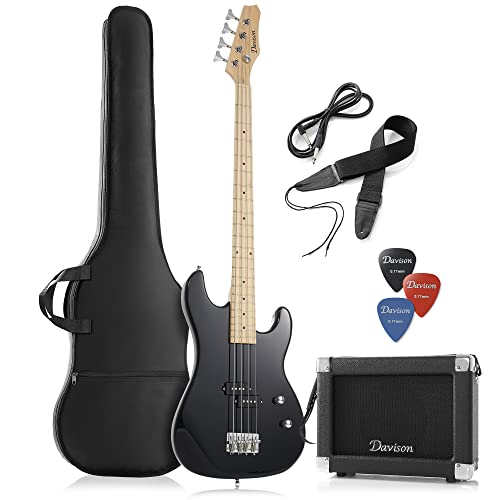
- ✓ Stylish high gloss finish
- ✓ Complete starter kit
- ✓ Solid sound quality
- ✕ Limited amplifier power
- ✕ Slightly heavy for beginners
| Scale Length | 34 inches (standard full-size bass guitar scale length) |
| Pickups | Dual P-style pickups |
| Neck Material | Maple |
| Fretboard Material | Maple |
| Strings | Four steel strings |
| Amplifier Power | 15W (30W peak power) |
Unboxing the Davison Full-Size Electric Bass Guitar Kit feels like opening a gift designed for serious players. The glossy finish instantly catches your eye, shimmering under the light, while the solid body feels sturdy yet lightweight in your hands.
The maple neck and fretboard look smooth and well-finished, inviting your fingers to glide easily over the steel frets. The included 15W amp is surprisingly compact but delivers enough power to fill a room, making practice sessions enjoyable without being overwhelming.
Setting up is straightforward—everything from the padded gig bag to the cable and picks is thoughtfully included. The guitar’s dual P-style pickups give you a clear, punchy sound, perfect for exploring different tones or low G tuning.
The adjustable truss rod offers easy customization, so you can tweak the neck for comfort.
Playing this bass feels natural, with the diecast tuners keeping tuning stable even during energetic sessions. The chrome bridge adds a classy touch, complementing the high-gloss finish.
Whether you’re just starting out or looking for a reliable practice instrument, this kit covers all bases.
While it’s excellent for beginners, advanced players will appreciate the solid build quality and attractive aesthetics. The only minor downside is that the 15W amp is best suited for small spaces—things might get loud if you crank it up in a bigger room.
Overall, this kit offers great value, combining style, functionality, and comfort. It’s ready to inspire your learning journey and impress friends when you show off your skills.
What Is Bass Guitar Scale Length and Why Does It Matter for Low G Tuning?
According to the Fender website, the standard scale length for most electric basses is 34 inches, which provides a balance between string tension and tonal quality, making it a common choice among musicians. Other sources, such as the Guitar Center, suggest that shorter scales can yield a warmer sound due to less tension, which is often preferred for specific genres or playing styles.
Key aspects of scale length include its direct influence on string tension and the ease of playing. A longer scale length tends to produce brighter tones with more sustain, as the strings are under greater tension. This is particularly important for low G tuning, where the bass is tuned down to G2 (the lowest G note on a standard bass). A longer scale length can help maintain clarity and articulation in the low frequencies, preventing the sound from becoming muddy. Conversely, a shorter scale length may make the lower notes easier to play but can compromise some tonal quality and clarity.
The significance of scale length is particularly evident in the context of low G tuning. When a bass is tuned down to this lower note, the string tension decreases, which can lead to a loss of definition in the sound if the scale length is not optimal. For instance, a bass with a 34-inch scale length in low G tuning will generally provide better definition and articulation than a 30-inch model, which may produce a muddier sound due to reduced tension and resonance.
Statistically, many professional bass players prefer a scale length of 34 inches for versatility across various tunings, including low G. Research from various musicians’ forums indicates that 34-inch scale basses are the most widely used in genres like rock, jazz, and metal, where clarity in the low end is essential. Furthermore, many manufacturers offer custom options for scale lengths, catering to the preferences of players who utilize alternative tunings.
The impact of selecting the appropriate scale length extends to performance and recording scenarios. A well-chosen scale length can enhance a player’s comfort, allowing for more fluid movement across the fretboard, especially when employing techniques like slap bass or tapping. Additionally, for recording, a bass tuned to low G with a suitable scale length will sit better in the mix, providing a solid foundation for other instruments without overwhelming them.
Best practices for achieving optimal performance in low G tuning involve selecting a bass with a suitable scale length and using appropriate string gauges. Lighter gauge strings may work well on shorter scales, while heavier strings can complement longer scales, ensuring a balanced sound. Regular setups and adjustments, including neck relief and intonation, are also recommended to maintain playability and tonal quality when tuning down.
How Does Scale Length Influence the Sound and Feel of Low G Tuned Bass Guitars?
The scale length of a bass guitar significantly impacts its sound and playability, especially when tuned to low G.
- Short Scale (30-32 inches): Short scale bass guitars produce a warmer, rounder tone with less tension on the strings, making them easier to play.
- Standard Scale (34 inches): The standard scale length offers a balanced tone with good sustain and clarity, suitable for a wide range of music styles.
- Long Scale (35 inches and above): Long scale basses provide increased string tension, resulting in a tighter sound that can enhance the articulation of lower notes.
Short scale bass guitars, typically between 30 to 32 inches, are favored by players seeking a more comfortable playing experience, particularly for low G tuning. This reduced scale length decreases string tension, which can lead to a fuller, warmer tone, making it easier to play complex fingerings without straining the hand.
Standard scale basses, usually around 34 inches, strike a balance between tonal depth and string tension. They deliver a clear, resonant sound that is well-suited for various genres, allowing for vibrant low G notes while maintaining a manageable string feel for most players.
Long scale basses, exceeding 35 inches, produce higher string tension which can enhance the clarity and precision of notes played in low G tuning. While this can result in a more pronounced attack and articulation, some players may find the increased tension requires more effort, potentially affecting playability during extended sessions.
What Are the Different Scale Lengths and How Do They Compare for Low G Tuning?
| Scale Length | Tension | Playability | Tone Quality | String Gauge for Low G Tuning | Example Models |
|---|---|---|---|---|---|
| Short Scale (30 inches) | Lower tension, easier on fingers | More comfortable for smaller hands | Warmer tone, less sustain | Use of lighter gauge strings (e.g., .045-.100) | Example: Fender Mustang Bass |
| Medium Scale (32 inches) | Balanced tension, versatile feel | Good for most players, offers a middle ground | Clearer tone with decent sustain | Use of medium gauge strings (e.g., .050-.105) | Example: Ibanez SR series |
| Long Scale (34 inches) | Higher tension, more resistance | Preferred by many for faster playing | Bright tone, excellent sustain | Use of heavier gauge strings (e.g., .050-.110) | Example: Fender Precision Bass |
| Extra Long Scale (35 inches) | Highest tension, can be challenging | Best for professional players | Very defined tone, strong sustain | Use of extra heavy gauge strings (e.g., .055-.115) | Example: Warwick Thumb Bass |
What Is the Ideal Scale Length for Optimal Performance in Low G Tuning?
Statistics suggest that many professional bassists gravitate towards a 34-inch scale length, as it strikes a balance between tension and playability. However, custom and boutique bass makers often provide options for varying scale lengths, enabling players to choose instruments that best fit their tuning preferences and playing styles. Ultimately, experimentation with different scale lengths can lead to discovering the most suitable setup for achieving optimal performance in low G tuning.
Best practices for bassists involve trying out different scale lengths and string gauges to find the ideal combination that suits their playing style. Additionally, using high-quality strings specifically designed for lower tunings can further enhance tone and playability, ensuring that musicians achieve the desired sound and feel when performing in low G tuning.
What Factors Should You Evaluate When Selecting a Scale Length for Low G Tuning?
When selecting a scale length for low G tuning on a bass guitar, several key factors should be evaluated:
- Scale Length: The scale length of a bass guitar significantly affects the tension of the strings and the overall sound. Longer scale lengths typically provide better tension and clarity in lower tunings, making them more suitable for low G tuning.
- String Gauge: The gauge of the strings you plan to use is crucial when tuning to low G. Heavier gauge strings can help maintain tension and prevent floppiness, which is especially important in lower tunings to achieve a clear and powerful tone.
- Neck Construction: The construction and materials of the neck can influence the instrument’s stability and playability. A well-constructed neck that can handle lower tunings without warping is essential for maintaining tuning stability and ensuring a comfortable playing experience.
- Fretboard Radius: The fretboard radius affects how comfortable the bass is to play, especially when using lower tunings. A flatter radius may facilitate easier fretting of lower notes, while a more rounded radius can provide a more traditional feel, impacting playability in low G tuning.
- Pickup Configuration: The type and placement of pickups can alter the tonal characteristics of the bass guitar. For low G tuning, pickups that can handle lower frequencies without muddiness are ideal, ensuring that the sound remains clear and defined.
- Body Style: The body style of the bass can affect resonance and projection. Different body shapes, like solid or semi-hollow, can impact how well the bass responds to lower frequencies, which is crucial when playing in lower tunings.
- Intonation: Proper intonation is vital when playing in low G tuning to ensure that the notes are in tune across the fretboard. A scale length that allows for easy adjustment of intonation can help maintain accurate pitch, especially in lower ranges.
What Are Some Recommended Bass Guitars for Low G Tuning Based on Scale Length?
When considering bass guitars for low G tuning, scale length plays a crucial role in string tension and playability.
- 34-inch Scale Bass: This is the standard scale length for most electric bass guitars and is suitable for low G tuning. The longer scale length provides better tension on the strings, which helps to avoid a floppy feel and retains clarity in the low notes.
- 35-inch Scale Bass: A 35-inch scale length can offer even greater string tension, making it ideal for low G tuning. This scale length is especially favored by players who want a tighter response and enhanced clarity, particularly in lower registers.
- 30-inch Scale Bass: Shorter scale basses, such as those with a 30-inch scale, can be used for low G tuning, but they may require heavier gauge strings to maintain tension. While they offer easier playability and a more comfortable reach, the lower tension might lead to a less defined sound in the low G range.
- Short Scale Basses (up to 32 inches): These basses are typically characterized by their compact size and are often favored by players seeking a more manageable feel. While they can be tuned to low G, careful selection of string gauge is essential to maintain sufficient tension and prevent the sound from becoming muddy.